


The History of Brazilian Jiu-Jitsu: From Judo to the Gracie Family
A century ago, a Japanese judoka taught grappling in Brazil. What his students built from it changed martial arts forever.
Every art has an origin story, but few are as well documented — or as consequential — as the one that produced Brazilian Jiu-Jitsu. It begins on the other side of the world from Rio de Janeiro, with a Japanese martial artist who carried judo across the globe, and ends with a global combat sport that reshaped how the world thinks about hand-to-hand fighting.
Mitsuyo Maeda brings judo to Brazil
In the early 20th century, Mitsuyo Maeda, a highly skilled judoka trained in the Kodokan tradition, traveled extensively demonstrating and teaching judo and jiu-jitsu around the world as part of a broader wave of Japanese martial arts spreading internationally. His travels eventually brought him to Brazil, where he taught the art to a number of students. Among them was Carlos Gracie, a young man who would go on to found what became one of the most influential martial arts families in history.
The Gracie family adapts the art
Carlos Gracie learned from Maeda and passed the art on to his brothers, opening an academy in Brazil to teach what they had learned. It was Carlos's younger brother, Hélio Gracie, who became central to the art's evolution. Hélio was physically smaller and lighter than many of the training partners and opponents he faced, and as the story is widely told, he adapted the techniques he'd learned to rely more on leverage, timing, and body mechanics rather than raw strength or size. That adaptation — refining judo's throws and grappling into a system where a smaller, weaker person could reliably control and submit a bigger, stronger one — is the philosophical core that still defines Brazilian Jiu-Jitsu today.
A martial art built on real challenges
The Gracie family built their reputation in part through open challenge matches, testing their art against practitioners of other styles to prove its effectiveness. This challenge culture instilled a practical, results-first mentality in the art from the very beginning — techniques that worked under real resistance survived, and techniques that didn't were discarded. That emphasis on live testing over choreography is part of why BJJ still trains primarily through sparring (called rolling) rather than pre-arranged forms.
UFC 1 and the introduction to the world
For decades, Brazilian Jiu-Jitsu was mostly known within Brazil. That changed dramatically in 1993, when the Gracie family helped create the Ultimate Fighting Championship as a way to showcase their art on a global stage. At UFC 1, Royce Gracie — representing the family and the style — defeated considerably larger opponents from different martial arts backgrounds using the same leverage-based grappling principles Hélio had refined decades earlier. Royce's success was a revelation for audiences who had never seen a smaller competitor calmly control and submit bigger, stronger fighters. It proved, on a public stage, exactly what the Gracie family had been demonstrating in challenge matches for years.
From novelty to global sport
UFC 1 didn't just make the Gracie family famous — it changed how every combat sport approached training. Fighters and coaches everywhere realized that grappling and ground fighting couldn't be ignored, and Brazilian Jiu-Jitsu spread rapidly to academies across the United States and eventually the entire world. What started as a family's adaptation of judo became its own distinct art, with its own competition federations, its own belt system, and millions of practitioners who may never set foot in an MMA cage but train BJJ purely as a sport, a fitness practice, or a form of self-defense.
Why the history still matters on the mats today
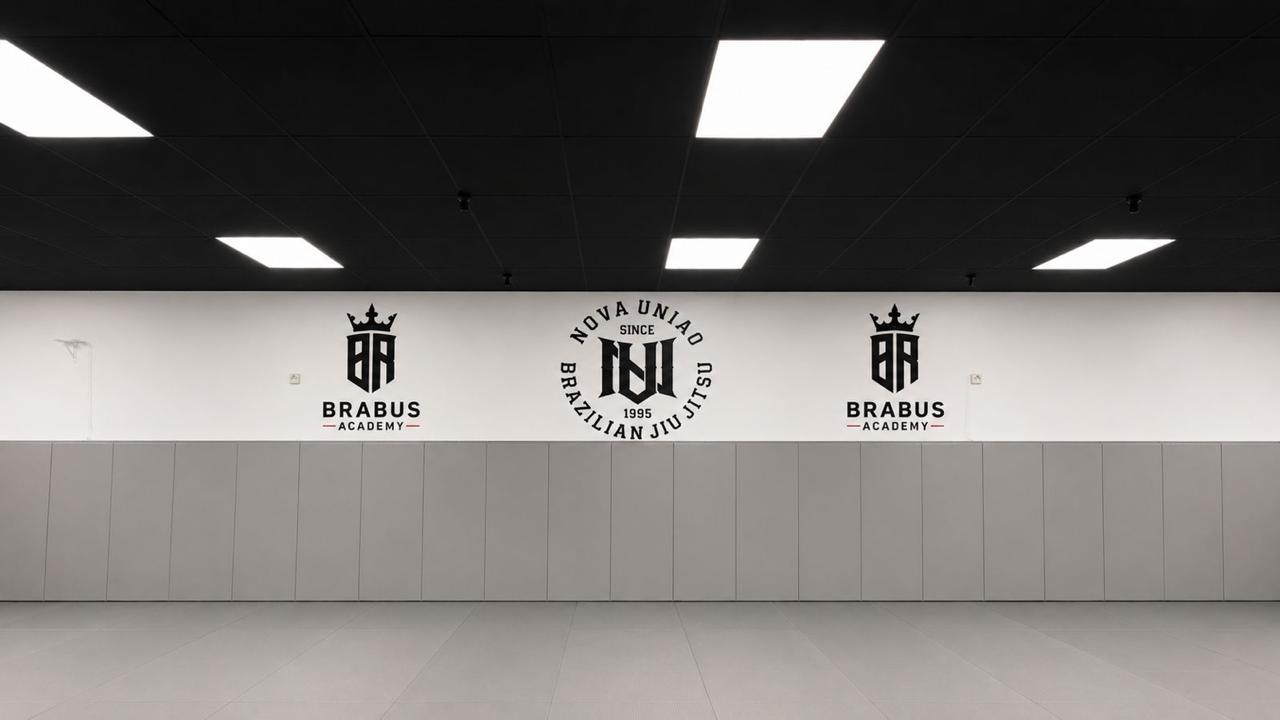
Every time you drill an armbar, escape mount, or work from guard, you're practicing techniques that trace directly back through this lineage — refined by Hélio Gracie, tested in real challenges, and proven on a world stage at UFC 1. Understanding that history gives context to why BJJ is taught the way it is: through live sparring, against real resistance, with a deep respect for technique over athleticism alone. That same philosophy is exactly what shapes the Nova União lineage carried forward at Brabus Academy today.
If this history makes you want to feel it for yourself, our Fundamentals program is the place to start, and your first class is free.
Come find out what you're made of.
No experience required. No commitment. Just step on the mat.
Start Free Trial