

Can Jiu-Jitsu Help Kids With ADHD Focus Better?
A careful, honest answer: many parents and instructors observe real improvements in focus — but this is anecdotal, not medical advice, and it isn't a treatment.
This is one of the questions we get most often from parents, and it deserves a careful answer rather than a marketing one. So let's be direct about what this article is and isn't. It is a summary of what many Jiu-Jitsu instructors and parents commonly observe in kids with ADHD who start training. It is not medical advice, it is not a claim that Jiu-Jitsu treats or cures ADHD, and it is not a substitute for guidance from your child's pediatrician or care team. If your child has an ADHD diagnosis, any decision about activities, routines, or treatment should be made in consultation with the professionals who know your child's specific situation.
What parents and instructors commonly report
With that framing in place, here's what we can honestly say: a lot of parents of kids with ADHD tell us their child seems calmer, sleeps better, and has an easier time settling into homework or dinner-table conversation on days they've trained. Instructors who've taught kids' classes for years often say the same thing from their side of the mat — that structured, physically demanding activity seems to help some kids with ADHD channel restlessness productively rather than fight against it all day. This lines up with what's widely understood, and not remotely controversial, about physical activity in general: exercise increases physical fatigue and is broadly recognized as helpful for mood regulation, sleep quality, and the ability to sit still afterward. None of that is unique to Jiu-Jitsu — it's true of most vigorous physical activity, and it's worth acknowledging plainly.
What might be specific to Jiu-Jitsu
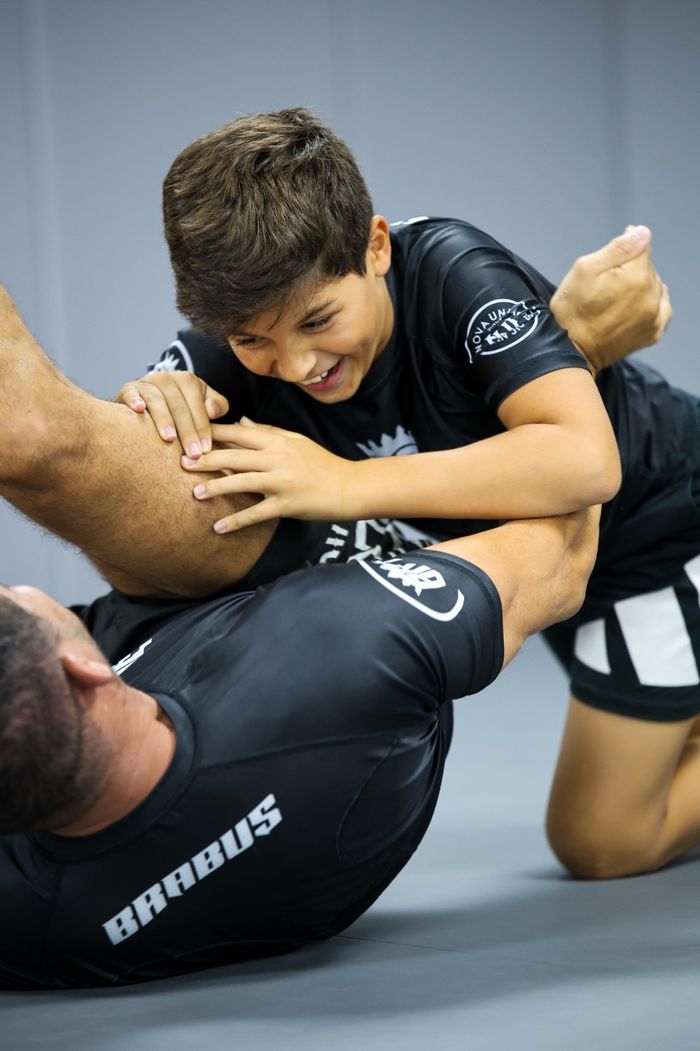
What some instructors and parents point to as more specific to Jiu-Jitsu is the structure of the class itself. Unlike free play or open gym time, a Jiu-Jitsu class is built around short, clearly defined tasks: watch this technique, now drill it, now switch partners, now try it against light resistance. That format gives a child frequent, concrete points to re-anchor their attention, rather than asking for forty-five minutes of undirected focus all at once. It also involves constant one-on-one correction — an instructor is regularly right next to a child, giving specific, immediate feedback, which some parents feel keeps their child engaged in a way that group instruction in a classroom setting sometimes doesn't.
Being honest about the limits of this
We want to be equally clear about what we can't claim. We are not aware of, and would never cite, a specific clinical study proving Jiu-Jitsu improves ADHD symptoms — and any website that tells you it has a magic percentage or a named study behind that claim should be treated with skepticism. What we're describing here is a pattern that many people close to the sport have noticed anecdotally, not a clinical outcome. ADHD is a diagnosed neurodevelopmental condition, and its management should be guided by qualified professionals — a pediatrician, a child psychologist, or a specialist familiar with your child's history. If your child is currently in treatment, whether behavioral, medical, or both, please continue following that plan and loop in your care team before making any changes based on anything you read here or anywhere else online.
- Many parents and instructors report better focus and calmer evenings after training — this is anecdotal, not clinical proof
- Structured, short-task class formats may suit some kids with ADHD better than unstructured free play
- Frequent one-on-one correction from instructors keeps many kids more engaged than group-only instruction
- This is not medical advice — always consult your child's pediatrician or care team about ADHD management
What we can offer
What we can genuinely offer is a safe, structured, positive environment where your child can try this out and see how it feels for them. Our Little Ninjas (ages 4–7) and Little Warriors (ages 8–12) programs run 45–60 minute classes with plenty of individual instructor attention, and no prior experience is required. Parents are always welcome to watch from the side, which means you can see for yourself how your child responds to the structure rather than taking anyone's word for it.
If you'd like to see whether this environment is a good fit for your child, take a look at our Kids & Teens program or schedule a free trial class — with no pressure and no commitment either way.
Come find out what you're made of.
No experience required. No commitment. Just step on the mat.
Start Free Trial