

A Parent's Guide to Your Child's First Jiu-Jitsu Class
The night before a first class, most of the nerves in the house belong to the parent, not the kid. Here's exactly what to bring, what to expect, and how to help without hovering.
You've booked the trial class. Maybe your child asked for this after watching a friend's belt promotion, or maybe you're the one who read about the benefits and decided it was worth a try. Either way, the days leading up to a first jiu-jitsu class tend to generate more parental anxiety than the class itself ever will. Here's what actually happens, and how to set your child — and yourself — up for a good first experience.
What to bring
A first trial class rarely requires special gear. Most academies, including Brabus, will let a new student borrow a gi (the traditional jiu-jitsu uniform) for their first class or simply train in athletic clothes if the class is a no-gi format. Beyond that, keep it simple:
- A water bottle with your child's name on it
- Comfortable athletic clothes (t-shirt and shorts or leggings) if not wearing a gi
- Hair ties for longer hair — it needs to stay out of the face and off the mat
- A small bag for shoes, since mat areas are always shoe-free
- Any inhalers or medical items the coach should know about, clearly labeled
Fingernails and toenails trimmed short are worth checking the morning of — long nails are one of the few things that can actually cause an accidental scratch during partner drilling, and coaches will thank you for handling it in advance.
What actually happens in the class
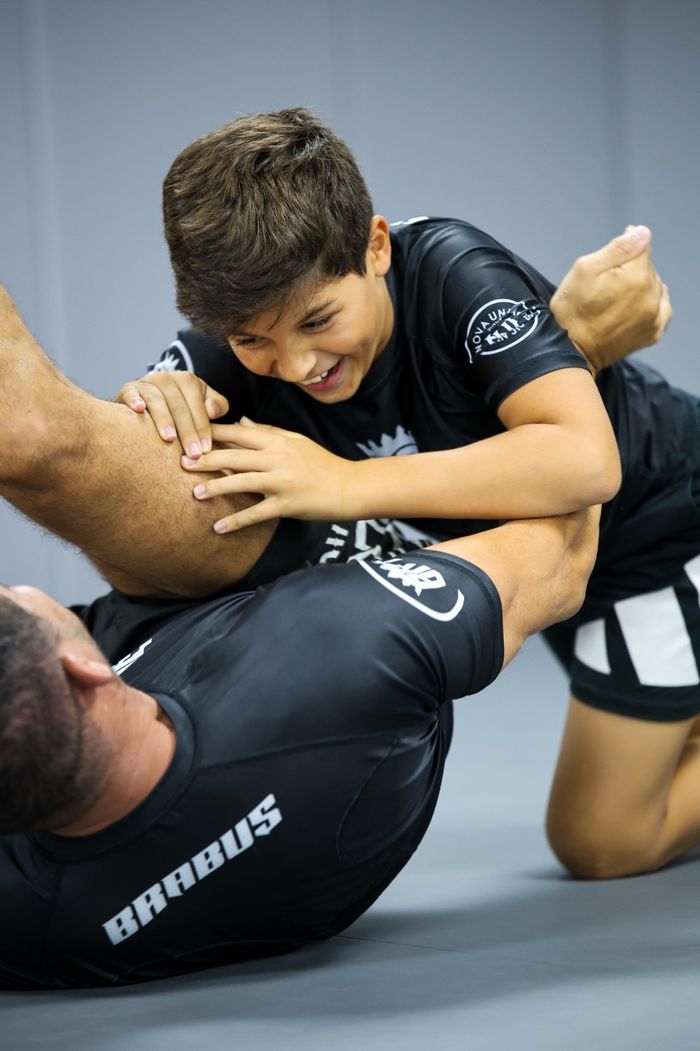
A typical kids class runs 45 to 60 minutes and follows a predictable rhythm: a warm-up (often disguised as a game so it doesn't feel like exercise), a technique breakdown where the coach demonstrates a move, partnered practice of that technique, and some form of live, controlled practice at the end — plus a closing line-up where the class bows out together. New kids are never thrown into full sparring on day one. Coaches build technical understanding first and introduce live rolling gradually, matched to a child's age, size, and comfort level.
Programs like Brabus's Little Ninjas (ages 4–7) and Little Warriors (ages 8–12) are structured specifically so a first-timer is never out of place — everyone in the room is at a beginner-friendly stage of the same curriculum, and the pace is built for kids that age, not scaled down from an adult class.
How to prep a nervous kid
Kids pick up on parental anxiety fast, so the most useful thing you can do in the car ride over is stay calm and matter-of-fact. A few things that genuinely help:
- Frame it as trying something new, not a test they can fail — there's no wrong way to have a first class
- Mention that everyone in the room started as a beginner once, including the coach
- Let them know it's normal to feel shy or unsure for the first few minutes
- Avoid over-hyping it as "so much fun you'll love it" — let the class speak for itself
If your child clings to your leg at the mat's edge, that's normal, not a red flag. Good coaches are used to easing reluctant kids in gently, and most children who start out hesitant are drilling alongside the group within a few minutes once the initial newness wears off.
What to do — and not do — from the sideline
Parents are welcome to watch at Brabus, and most academies encourage it, especially for a first class. But there's a real difference between watching supportively and coaching from the sideline. Calling out corrections, cheering loudly during drills, or mouthing instructions through the glass can actually undercut what the coach is building: a room where kids learn to take direction from their instructor and problem-solve with their partner, not look to a parent for the answer.
The most helpful thing a parent can do during class is simple — sit back, let the coach coach, and save the debrief for the car ride home. Ask open questions afterward: "What was your favorite part?" or "What was tricky?" tend to get better answers than "Did you win?" (Jiu-jitsu, especially for young kids, isn't about winning a given round — it's about steadily building skill.)
After the first class
Don't expect a verdict after one session. Some kids come off the mat buzzing; others are quiet and non-committal, even if they secretly enjoyed it. Give it two or three classes before drawing conclusions — the newness wears off, the routine becomes familiar, and most kids settle in once they know what to expect walking through the door.
Ready to see it for yourself? Explore the Kids & Teens program or book your child's free trial class at Brabus Academy in Lake Mary.
Come find out what you're made of.
No experience required. No commitment. Just step on the mat.
Start Free Trial