

Real Self-Defense Skills Every Kid Should Have
Good self-defense for kids has almost nothing to do with learning to throw a punch. It starts with awareness, boundaries, and confidence — with physical technique as the last piece, not the first.
When parents ask about "self-defense" for their kid, they're often picturing something aggressive — kicks, strikes, a kid who can fight back. The reality of good, age-appropriate self-defense instruction looks almost nothing like that. The most important skills a child can build for personal safety are things they'll use dozens of times without ever throwing a technique: noticing what's happening around them, saying no clearly, and knowing when to get away and get help. Physical skills matter, but they sit at the bottom of the list, not the top.
Awareness comes first
The single most protective skill a child can develop is simply paying attention to their surroundings and their own instincts — noticing when a situation feels off, recognizing unfamiliar adults who are being unusually persistent, and knowing where the exits and trusted adults are in any given space. This isn't a jiu-jitsu-specific skill, but training in a martial art setting reinforces it constantly, because coaches spend real time talking through scenarios with kids: what to do if a stranger approaches, what to do if a peer won't stop physically bothering them, when to speak up and to whom.
Boundaries: saying no and meaning it
A huge percentage of real-world situations kids face — with peers, not just strangers — are boundary problems, not fight-or-flight emergencies. Someone won't stop grabbing at their things, someone is standing too close, someone keeps pushing during a game. Kids who've spent time in a structured martial arts environment tend to get comfortable with something surprisingly hard for many children: saying "stop" firmly, out loud, and meaning it. Jiu-jitsu practices this directly and constantly — every time a child taps out or tells a training partner they're going too hard, they're rehearsing the exact skill of setting a clear boundary and having it respected immediately.
- Notice surroundings and trust their own sense that something feels wrong
- State a boundary clearly and firmly — "stop," "no," "get away"
- Know that telling a trusted adult right away is never "tattling"
- Understand physical technique as a last resort, not a first move
- Stay calm under pressure instead of freezing or escalating
Confidence over aggression
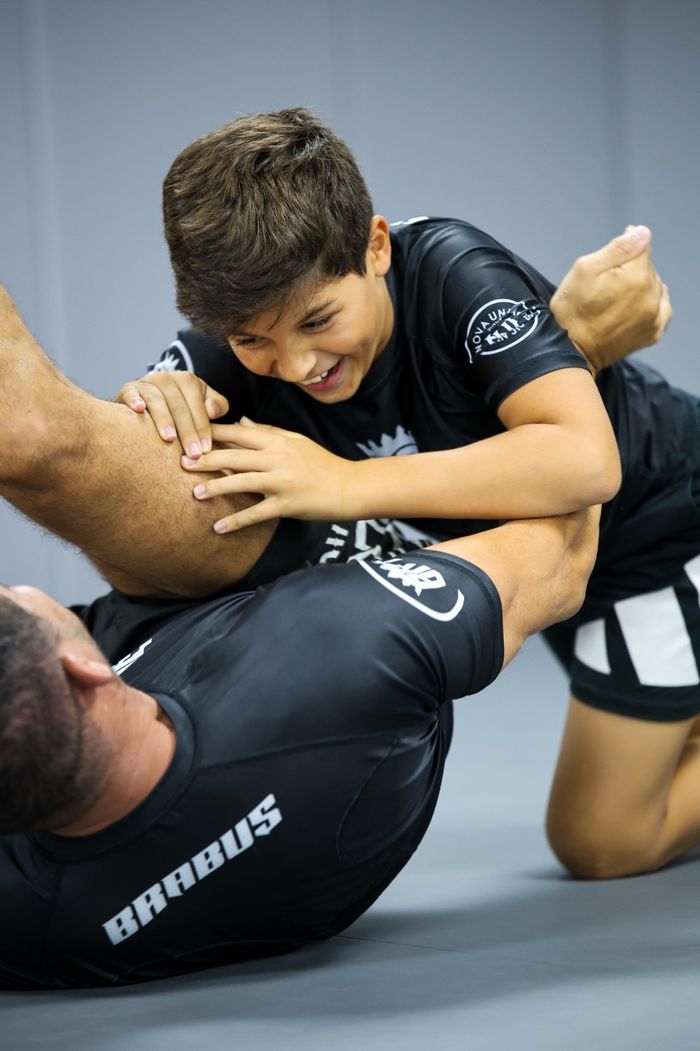
One of the most consistent things instructors and parents report about kids who train jiu-jitsu is a change in how they carry themselves — not more aggressive, but calmer and more grounded. That distinction matters enormously for real-world safety. A child who's anxious or uncertain tends to read, to people who might target them, as an easier mark. A child who moves through the world with quiet, physical confidence — not bravado, just a settled sense that they can handle themselves — is a much less appealing target in the first place. This is sometimes called the "great equalizer" effect of jiu-jitsu: it's a sport built around a smaller, weaker person being able to control a larger one through leverage and technique rather than strength, and that principle shapes a child's whole demeanor, not just their physical skill set.
Physical technique as the actual last resort
Only after awareness, boundaries, and confidence does physical technique enter the picture — and even then, the goal taught in a well-run kids' program is control and escape, not aggression. Jiu-jitsu is particularly well suited to this because so much of the art is about neutralizing and controlling a situation from a defensive position rather than striking. A child who has drilled how to get back to their feet, create space, and get away is far better equipped for an actual worst-case scenario than a child who's memorized a few punches but never practiced controlling their own fear or getting off the ground under pressure.
Good instructors are explicit with kids about this hierarchy: avoid, de-escalate, get away, tell an adult — and only use physical skills if there's truly no other option. That framing matters as much as the technique itself, because it teaches restraint alongside capability.
What this looks like at Brabus
In the Little Ninjas (ages 4–7) and Little Warriors (ages 8–12) programs, self-defense concepts are woven into age-appropriate drilling rather than taught as a separate "stranger danger" unit. Coaches build awareness and boundary-setting into everyday class conversations, and the physical curriculum naturally builds the calm, controlled confidence that underlies real personal safety. Explore the Kids & Teens program or book a free trial class to see how it comes together.
Come find out what you're made of.
No experience required. No commitment. Just step on the mat.
Start Free Trial