

Little Ninjas & Little Warriors: How Brabus Structures Kids Classes by Age
A six-year-old and an eleven-year-old don't learn the same way, move the same way, or need the same coaching. Here's why Brabus splits kids' jiu-jitsu into two distinct age-banded programs instead of running one class for everyone.
Walk into a lot of youth activity programs and you'll find a single "kids class" spanning a wide age range, with a coach doing their best to keep both the youngest and oldest kids engaged at once. It rarely works well for either end of that range — younger kids get lost trying to keep up, and older kids get bored waiting for the group to catch up. At Brabus, kids' jiu-jitsu is split into two purpose-built programs instead: Little Ninjas for ages 4 to 7, and Little Warriors for ages 8 to 12.
Why age-banding actually matters
Attention span, coordination, emotional regulation, and physical strength all develop at very different rates across early and middle childhood. A curriculum built for a four-year-old — short activities, lots of movement variety, simple instructions repeated often — would bore an eleven-year-old within minutes. Flip it around, and the more demanding technical instruction an eleven-year-old can handle would overwhelm a four-year-old who's still building basic listening and coordination skills. Splitting the age range lets each class actually meet kids where they are, rather than compromising for everyone in the room.
Little Ninjas (ages 4–7)
This is often a child's very first structured activity outside of preschool or early elementary school, and the class is built around that reality. The focus at this age is less about technical mastery and more about foundational skills: listening to an instructor, following multi-step directions, taking turns, and building basic coordination and body awareness through playful, movement-based drilling. Jiu-jitsu concepts are introduced through games and simple repeated movements rather than dense technical instruction, and the pace of the class is built around what a young child can actually sustain — shorter activity blocks, frequent variety, and a lot of positive reinforcement.
Parents of Little Ninjas students often see the biggest early gains not in jiu-jitsu technique itself, but in things like following directions at home, sitting still for a few extra minutes, or handling a small disappointment more calmly — the foundational behaviors the class is quietly building alongside the martial art.
Little Warriors (ages 8–12)
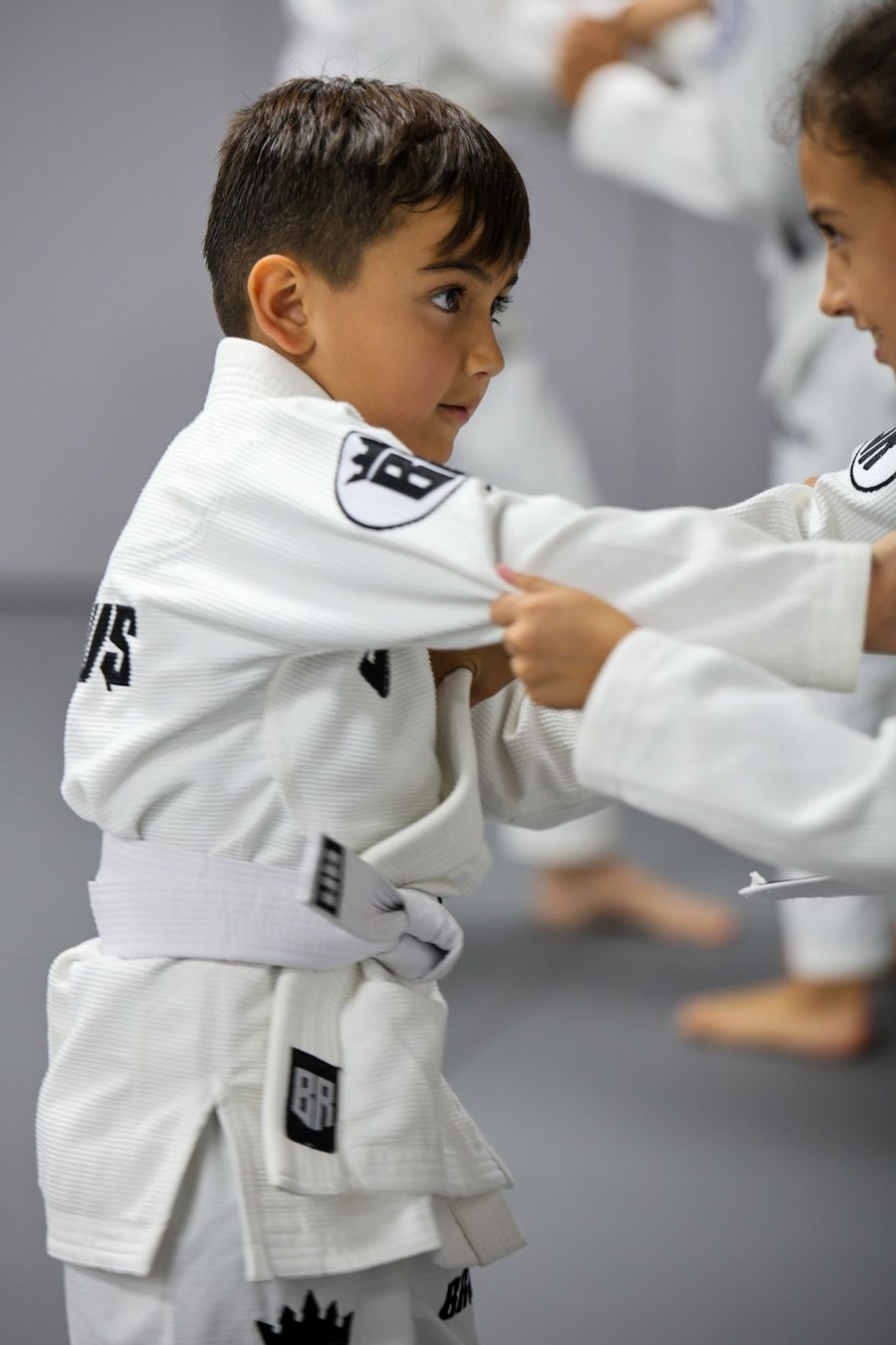
By this age range, kids can generally handle real technical instruction, longer periods of sustained focus, and more demanding physical work. Little Warriors classes go deeper into actual jiu-jitsu technique — proper positioning, escapes, submissions appropriate for this age group, and controlled live practice with partners. The belt and stripe system becomes more meaningful here too, since kids at this age understand and value the idea of working toward a visible marker of progress. Discipline expectations rise accordingly: more structured warm-ups, more emphasis on precision, and coaching that treats students as capable of real technical growth rather than just play-based learning.
This is also the age range where jiu-jitsu's effect on focus and follow-through tends to become most visible to parents — kids at this stage are old enough to notice their own progress and to connect the discipline they're building on the mat with things like schoolwork and responsibilities at home.
- Little Ninjas (4–7): coordination, listening, and confidence through playful, structured jiu-jitsu
- Little Warriors (8–12): real technique, discipline, and focus that carries into school and home
- Classes run 45 to 60 minutes — long enough to build skill, short enough to hold attention
- No-Gi kids classes are available for both age groups on Tuesdays & Thursdays
- No prior experience needed for either program — every child starts as a true beginner
A safe, structured, positive environment either way
Regardless of which program a child lands in, the underlying philosophy is the same: a safe, structured, and positive room where progress is measured against the individual child, not compared harshly against peers. Parents are welcome to watch either class, and coaches are trained to hold a consistent standard of respect and effort while keeping the experience genuinely enjoyable for kids at that specific stage of development. The goal isn't to rush a four-year-old into advanced technique or to slow down an eleven-year-old with material they've outgrown — it's to meet each child exactly where they are.
Not sure which program fits your child? Explore the Kids & Teens program for the full breakdown, or book a free trial class and we'll get them into the right room.
Come find out what you're made of.
No experience required. No commitment. Just step on the mat.
Start Free Trial